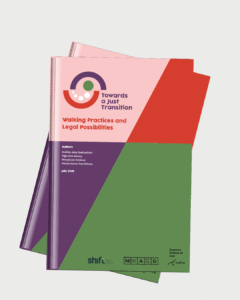
New Report: Towards a Just Transition – Walking Practices and Legal Possibilities
We are pleased to share our new report, prepared in collaboration with Erasmus University, in which we explore walking as a method of research and learning. Written in English and authored for the Center for Spatial Justice (MAD) with contributions from Hüseyincan Eryılmaz and Yağız Eren Abanus, the publication brings together research experiences from Türkiye and the Netherlands. It examines how walking can be used as a method in just transition work, while also reflecting on how knowledge is accessed—or not—whose knowledge is heard, whose voices remain marginal, and how all of these dynamics are deeply intertwined with questions of justice.
Walking, as a method, has been a core part of the Center for Spatial Justice’s work since its founding. Through walking, we seek to understand spatial relations, to trace the memory of struggles for justice in urban and rural contexts, and to engage with spatial decision-making processes. We walk through cities and along their edges, in riverbeds, gardens, and village squares—moving by listening, observing, and staying in close contact with place.
Our walks bring together people from different fields and life experiences: researchers, students, professionals, civil society actors, artists, and local residents. Knowledge of a place emerges through encounters—with the stories and narratives of those who live there, and through interactions with both human and more-than-human elements. The cold of the weather, a chance conversation, a plant encountered along the way, or a particular smell can open up new connections and give new meaning to what we thought we already knew.
At times, our research requires shifting focus and scale. To grasp the impacts of mega-projects, infrastructure developments, or energy investments, we step back and look from a distance—turning to maps, official documents, civil society reports, and legal frameworks. At other moments, we move closer, focusing on individual stories, the voice of a neighbourhood, or the needs of a community. Working across these different scales allows us to make sense of social and spatial relations in all their complexity. Our previous walking practices—#BizimMahalle, DereTepe River Basin Studies, the Political Ecology Summer School, and Thermal Walks—have all unfolded along similar lines. When combined with other research methods, walking becomes a way of telling and sharing the stories of places and people, and of creating knowledge collectively.
Our most recent example of this practice is the Thermal Walk carried out in June 2025, where citizen science played a central role. Organised within the framework of the “Sivil Katılım Hibe Programı,” with the support of the European Union and in collaboration with Maltepe Municipality, the walk explored how the city copes with extreme heat. Together with citizen researchers, we collected data using relatively accessible tools such as thermal cameras, sensors developed by participants, GPS, WhatsApp groups, and smartphones. We worked collectively to identify and record where heat intensifies, where it dissipates, and who experiences greater difficulty or relief. These findings not only deepened our shared understanding as citizen researchers, but were also shared with the municipality as a resource to support policies and preparations for heatwaves.
Around the same time, we met Dr. Siobhán Airey and Daniela Garcia-Caro Briceno from Erasmus University’s Faculty of Law. Our respective work on Just Transition, combined with our walking-based research experiences, created a shared ground for discussion. We reflected together on how relationships between academia and civil society can be built, and on the values that should guide knowledge production. Siobhán and Daniela’s visit to Istanbul and their participation in the Thermal Walk transformed these conversations into a collective process of thinking and producing. The conversations we had while walking, the stories we listened to, and the experiences we shared—both converging and diverging—eventually came together in a joint publication.
We hope this work will inspire further research, collaborations, and shared learning processes.